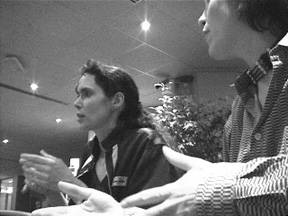
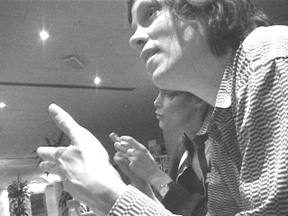
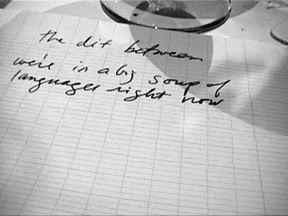
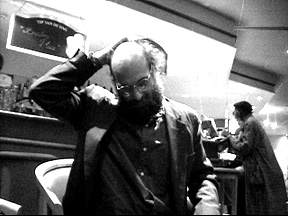
at the table: Joseph Grigely; a member (or 2 at times) of Laboratoire Agit-Art from Senegal; Amy Vogel; Anne Walsh
Anne Walsh translates French/English
Amy Vogel translates English/Sign-Language
Anne: He said that often when people are interested in art, they forget that there's an artist involved & what they're interested in doing is that when they agitate & they stir things up in art, its not that different from science.
NIB: What have you found to be some of the similarities, in terms of process, between artists & scientists?
Anne: He said that his brother over there at the bar has shown that, for example, in the time of Leonardo DaVinci, art & science were not separated & that it's only over the course of time that it's been separated & they consider it a purely semantic difference.
NIB: How has the separation occurred-- what made it possible?
Anne: He's going to explain in three points.
The first point is out of economic necessity. The second is social necessity. The third one is difficult to describe because it implies a return to the first point.
It's because, unlike art which is pretty much common to everyone, science is much more a defined & llimited field practiced by a select group of people. People who develop sciences essentially colonize the world through science.
Joseph: What science is now trying to do is colonize the human body by trying to map the genome. That's a kind of colinization.
Anne: The geonome is the sum total of our genes. For our species the genome is the same no matter what the race. 95% of our genes are exactly the same as chomps. 100% of people have the same genes regardless of race. But we've seen over the evolution of people in time that there are groups whose genomes have changed. But it's not the whole group-- it's a part of the group that changes. That's what causes the evolution of the species.
Joseph: Yes, I agree. But the important thing now is how science is trying to change the genome-- control it, alter it. That is a kind of colonization of the body.
Anne: It's frightening because we don't know the consequences. It's frightening that we've reached this period, but this is the level that human intelligence has reached & every time that happens, it's frightening.
So, for instance, at the moment that civilization made the change from hunting to agriculture, animals in the home became a scary thing because the culture was in the process of transitioning from one relationship with animals to another relationship with animals.
Joseph: HAMBONE!
Anne: Il a dit le nom de son chien, s'apelle Hambone.
He understands, but changes in human evolution have always been frightening & they're just continuing to be frightening. It's never been any different.
Joseph: What is it that you think people are afraid of? What is the root of the fear?
Anne: He said he can't speak for others; he has his own fears.
I asked him what he's afraid of. He said he doesn't think about fear he just thinks about questions. He says that as long as he's searching, he's living. The solution is in his life.
Joseph: For all of us.
Anne: I said that I thought it was a really beautiful way to understand change, to deal with it as a question, rather than something to be fearful of. & he said 'well I'm not looking for beauty' & I said 'well I'm not complementing you on that, I appreciate that.' He says that he wants to ask you a question-- only one.
He wants to know whether Joseph believes humanity is heading towards its proper destiny or not. He said he took all of Joseph's questions & summed them up into one question.
(people laugh & rub hands together in anticipation)
Joseph: The question of proper destiny assumes that there may be a question of improper destiny. I believe very much in the sense of possibility. That's why we're all here together.
Anne: He's going back to his question.
He says that Joseph's question was in the manner of a philosopher who responds to a question with another question.
Joseph: I do not mean to be rehtorical. I believe in being concrete-- being real. The person you sit with & speak with is real. I'm not trying to be philosophical or abstract, but real & pragmatic.